
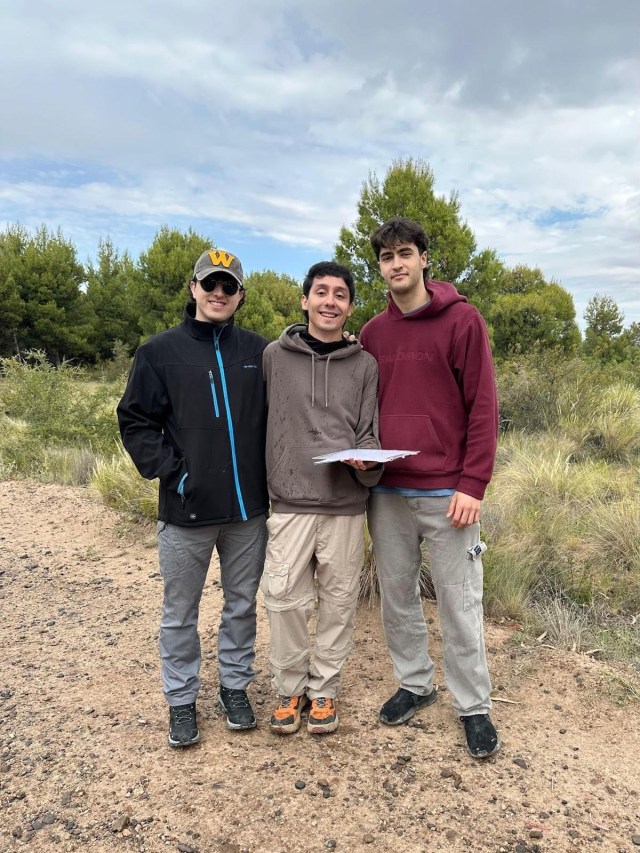
This blog is authored by Eros, Franco (@fran_crespillo), and Lucio, three Geology students at National Comahue University (Universidad Nacional del Comahue, UNCo) in Neuquén, Argentina.
This is part of our “Ground Beneath our Feet” series by students at the Universidad Nacional del Comahue in Argentina. Each piece is aligned to the UN Global Sustainable Development Goals. This blog is aligned to Global Goal 7: Affordable and Clean Energy.
We observed that in the region we study, Neuquén and Río Negro, which are part of Patagonia, the main source of energy is oil & gas. With the boom of fracking (a unconventional method of oil extraction), many different opinions and points of view have recently emerged throughout the community. Therefore, we believe that sharing our knowledge about other clean energies, such as geothermal energy, could be very beneficial for the community.
Geothermal energy utilizes the heat of the Earth to raise the temperature of an aquifer. This hot water reservoir can be used to move a turbine and generate electricity, or it can be used in houses for heating systems. We asked ourselves: How can we raise awareness and promote this great source of energy?
We aimed an awareness campaign at students and the community of our University, with all its colleges and departments, so we could measure a small but representative group of people.
Existing perceptions
First, we had to know how much previous knowledge people had about geothermal energy. To quantify this, we created a survey with basic theoretical questions and personal opinion questions about the degree of interest and acceptance as a source. This survey was sent via WhatsApp to our contacts, and we uploaded a QR code to our social media so people could scan it to complete the survey.
This first poll helped us to see a clear difference: students from science faculties—that is, with degrees more related to geology (e.g., engineering faculty)—had a greater basic knowledge than students who belonged to faculties more oriented towards politics or social sciences (law, social sciences, economics, etc.).
So, we aimed the campaign to raise the level of knowledge of students who are not familiar with this type of clean and renewable energy.

Geyser located in the northern area of our province
Our campaign
This campaign consisted of distributing flyers and digital infographics with key information about geothermal energy, such as how it works, its advantages and disadvantages, and a brief overview of the relationship between this energy and the environment and the economy. We used Canva, which is a free tool for creating images without needing any graphic design knowledge. The posters we created as part of the campaign are shown below, with their open-access links.

You can find our campaign materials here! https://drive.google.com/file/d/1LeiVNPwn4b8rQqjI0VvUxNcmSpnhbwqP/view?usp=sharing

You can find our campaign materials here! https://drive.google.com/file/d/17EGOZuhayLRFUkNpBcdS0XLWWnM5Nyci/view?usp=sharing

You can find our campaign materials here! https://drive.google.com/file/d/1F2yP-H77-oK30YPZIFGH1k2qHDoF95ka/view?usp=sharing
What impact did we have?
We created a second survey to measure our impact on basic knowledge, and to find out how much their opinion changed regarding the acceptance and awareness of its use within the framework of an energy transition towards cleaner sources in our country, following the guidelines of the UN’s 2030 Agenda. The results were more or less as expected, achieving a level playing field in technical knowledge among students across the university community and receiving positive feedback regarding its acceptance.
The future energy mix
To conclude, we want to comment on what we hope to achieve with this. We do not want to stop the exploitation of such a valuable resource as oil and gas, since it generates many jobs and is the main economic driver of the region. However, we must not forget that if it is extracted irresponsibly, the damage and pollution to the environment can be very significant, destroying habitats and contaminating aquifers, rivers, or lakes through spills. Therefore, what we want to achieve is to raise awareness and knowledge among future professionals about this valuable resource that we have in our province so that, in the future, it can be harnessed and utilized, generating more jobs and greater diversity in the region’s energy mix.